
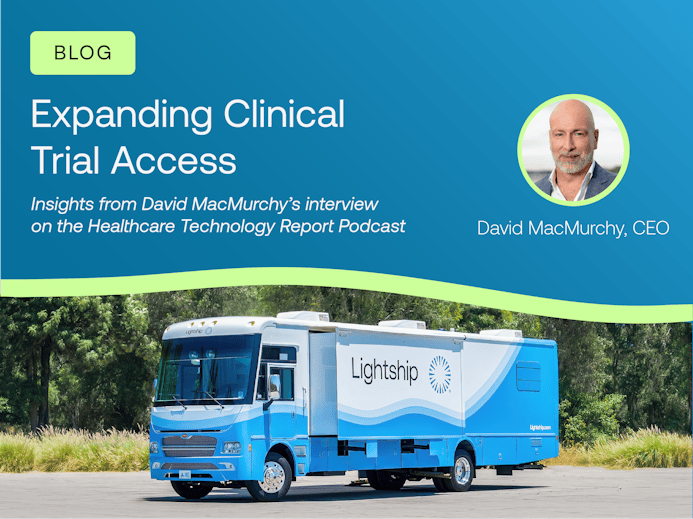
In a recent episode of The Healthcare Technology Report podcast, Lightship CEO David MacMurchy spoke with host RJ Lumba about the company’s mission and the lessons he’s learned from a career spent with some of the industry’s largest organizations. The conversation traces Lightship’s role in expanding access to clinical research, the structural barriers that persist for many communities, and the leadership principles guiding the company as it scales.
Read the highlights from David’s conversation below.
Lightship’s flexible engagement model is expanding access by meeting patients where they are.
David begins by discussing Lightship’s core mission: to make it possible for all people to join clinical trials. By delivering flexible on-site, hybrid, and virtual trials, Lightship is able to reach participants that might not otherwise be able to take part in research due to their location, work, or family responsibilities. Mobile research units (MRUs) support all delivery models; Lightship parks these units in the community, such as retail parking lots or near local events. Staffed by Lightship nurses, MRUs can be paired with in-home visits to complete appropriate endpoints, which makes trial participation far more realistic for people juggling work and caregiving.
David notes that “by far and away, the most successful and most surprising part of the growth of the business has been recruiting by actually going into communities and meeting people where they are.” For example, nurses and staff attend Alzheimer’s walks and health fairs to talk directly with families who are curious about research. Those conversations flow into a growing database of participants, supported by partnerships with health systems, collaboration with local sites, and targeted digital outreach. According to David, because Lightship reaches participants who don’t live near traditional trial sites, its recruitment funnel is broader than a standard site model. This supports faster enrollment and strong completion, with a retention rate of 96%. Or, as David puts it simply, “[The model] works pretty well.”
Solving for structural inequities in clinical trial access and increasing representation
Lightship’s model is built to tackle the structural issues that keep many people out of research in the first place. David talks about the tight link between lower socioeconomic status and lack of access to clinical trials, and how that aligns with the long-standing underrepresentation of people of color in U.S. studies.
Time is a large barrier to participation; a burden compounded for those in large cities like Los Angeles or New York, where a few miles of travel can mean hours in traffic. For many people, taking time off work for repeated clinic visits simply isn’t possible. David says that even when someone is referred to a trial and expresses early interest, “they may sign up for it, but they never complete the study because it’s just too much of a burden on them.”
David says that by meeting people close to where they live and work through virtual, hybrid, and mobile visits, Lightship reduces that burden in a very practical way. Participants can stay in trials over several months or years without risking their jobs or income. That leads to better retention, more representative enrollment, and higher quality data that reflects the communities therapies are meant to serve.
David’s history, leadership, and a disciplined approach to scaling Lightship
David’s career across Pfizer, PRA Health Sciences, IQVIA, and Ernst & Young shaped how he thinks about building and scaling a company in a high-stakes environment. He saw how delayed or under-enrolled trials strain R&D teams and redirect budgets, which led him to a simple conclusion when founding Lightship: solving for access, enrollment, and retention delivers value for sponsors and better outcomes for participants.
Lightship’s growth strategy reflects that point of view. David emphasizes scaling in a way that protects quality because the team is delivering real clinical care. He notes that “[r]apid, rapid growth…it puts a risk on quality, and quality is central to what we do.” Lightship’s investors and leaders support that measured approach. As Lightship expands, Chief Operating Officer Darcy Forman and Chief Business Officer Michael Shipton play a central role. Both bring deep operational experience and a shared commitment to patient experience and thoughtful, sustainable growth, ensuring Lightship scales responsibly while staying grounded in its mission.
David’s leadership ethos sets the tone for this approach. He is candid about what he knows and what he is still learning, and he seeks partners who value transparency and honest problem-solving. Advice from mentors about finding purpose in the work continues to guide him, and for David, that purpose is clear: expanding access to research and improving outcomes for communities historically left out of clinical trials.
If you would like to learn more about Lightship’s model or explore partnership opportunities, we’re always open to a conversation. Visit www.lightship.com or reach out to our team to connect.